

logo

Welcome to Thrive

THRIVE is a collaborative platform of conventional, integrative, & functional medicine practitioners coming together in one setting to provide personalized healthcare to clients.
Working Hours
Monday - Friday 8:00AM - 5:00PM EST

Cart

M - Th 8a - 5p, F 8a - 4p, Sa 10a - 1p, Su - Closed

(704)-390-7150

6401 Carnegie Blvd, Suite 2A, Charlotte, NC 28211

Top

Health

Thrive Carolinas / Health
Couple embracing under a sunset, symbolizing connection, intimacy, and whole-body wellness

A Valentine’s Aphrodisiac That Lasts: How Whole-Body Health Supports Desire

Valentine’s Day tends to focus on grand gestures, flowers, chocolates, and reservations made weeks in advance. But if we’re honest, romance doesn’t start with what’s on the table. It starts with how you feel in your body. Energy. Mood. Hormonal balance. Confidence. These are the real aphrodisiacs, and February is a perfect time to focus on them. As we head into Valentine’s Day 2026, consider this your reminder: supporting intimacy is really about supporting health. Desire Is a Whole-Body Conversation Libido isn’t controlled by a single switch. It’s influenced by ongoing conversations among hormones, metabolism, stress levels, sleep quality, and nutrition. When one piece is out of sync, chronic stress, poor sleep, blood sugar swings, and nutrient deficiencies often take a back seat. That’s why quick fixes rarely work. Sustainable intimacy comes...
Share
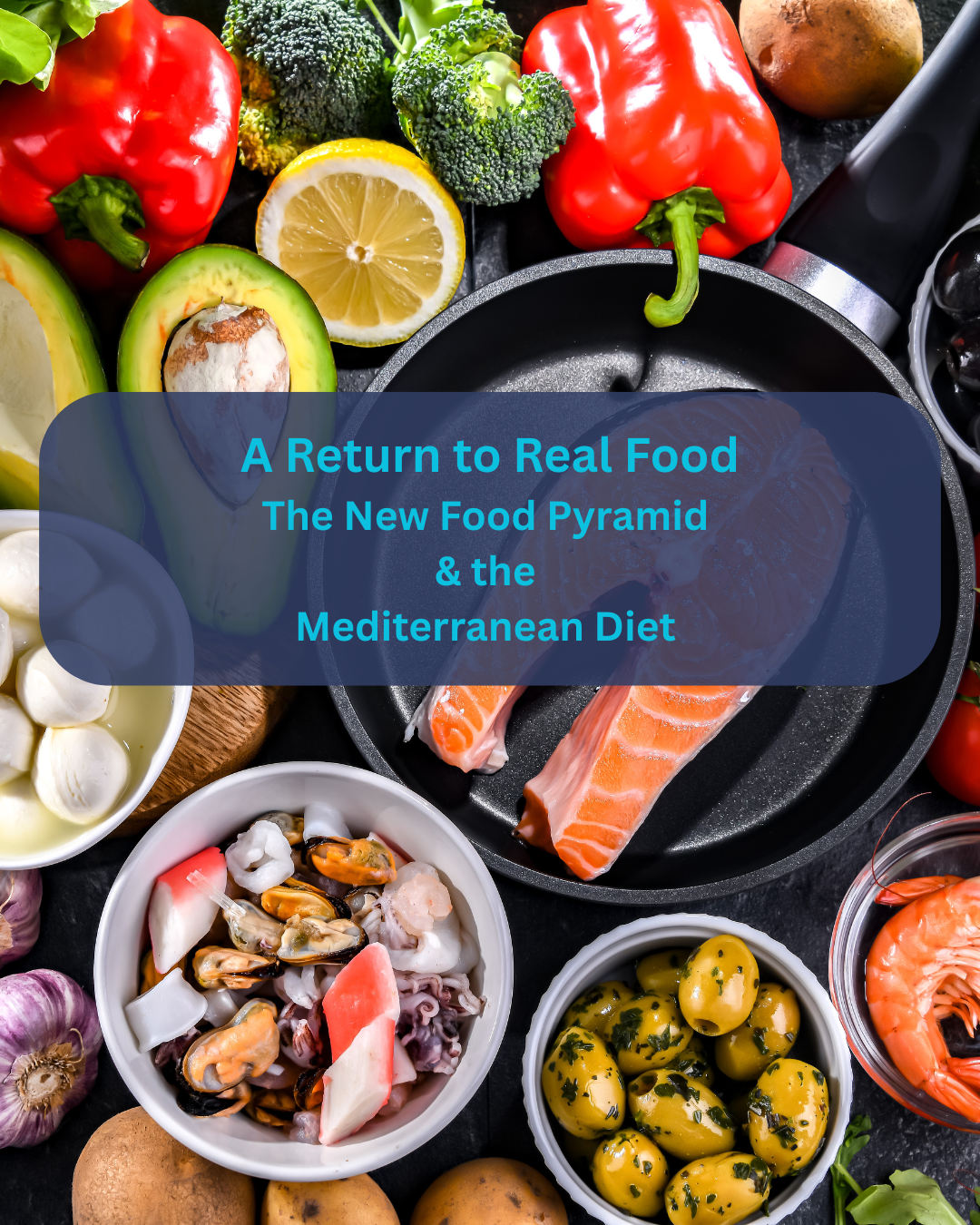
Colorful Mediterranean meal with olive oil, vegetables, legumes, fish, and whole foods arranged on a shared table.

The New Food Pyramid & the Mediterranean Diet: A Return to Real Food

By Nancy A. Palermo, MD The newly released 2025–2030 Dietary Guidelines represent one of the most meaningful shifts in federal nutrition policy we’ve seen in decades. For the first time in a long while, national guidance is beginning to align with what science and common sense have been telling us all along: real, whole foods support health, while highly processed foods drive disease. From a Functional Medicine perspective, this change is long overdue. The updated guidelines are illustrated using an upside-down food pyramid, emphasizing whole, nutrient-dense foods at the foundation, particularly protein, healthy fats, and lower-glycemic carbohydrates. While the recommendations are not perfect, they signal an important shift toward prevention, metabolic health, and longevity. At its core, this new pyramid closely mirrors the principles of the Mediterranean diet, one...

Share

Cooking at Home: A Non-negotiable Tool to Optimize Health

“Any valuable tool should be simple. That does not mean it will be easy, but if it does need to be simple.” One of the most powerful tools for optimizing your health is a balanced diet. The only way to truly control your diet is to cook at home. When you cook your food, you know where the ingredients came from and what you put into the recipes. That is why we are so passionate about sharing kitchen ideas and recipes. Even before opening our doors at Thrive, we provided cooking classes at Whole Foods. We know that to aid our patients on their health journey, motivating them to cook is key. Cooking does not have to be intimidating or complicated. The more you make cooking at home a...

Share

Why 10,000 Steps a Day Isn’t the Magic Number

By Nancy A. Palermo, MD You’ve probably heard the popular health advice: “Get 10,000 steps a day.” But is this daily step goal rooted in science? The Origin of the 10,000-Step Myth Surprisingly, the 10,000-step recommendation didn’t come from medical research; it originated from a Japanese pedometer marketing campaign in the 1960s. Since then, it’s been widely adopted by health apps, fitness trackers, and wellness guidelines—despite lacking clinical evidence. What the Research Really Says A 2023 meta-analysis published in The Lancet reviewed multiple studies from 2014 onward, analyzing the impact of daily step counts on chronic health conditions. The researchers found that significant health benefits occur at much lower step counts than 10,000. In fact, just 7,000 steps per day was associated with the following risk reductions (compared to 2,000 steps/day): ...

Share

Are Hidden Chemicals in Your Food Packaging Harming Your Health?

More than 10,000 chemicals are still approved for use in food and food packaging materials in the United States, and many of them may be doing more harm than good. A growing body of research shows that many of these chemicals are endocrine disruptors, meaning they interfere with your body’s hormonal systems. These disruptions can contribute to a wide range of health problems, including developmental, reproductive, neurological, and immune disorders. Where Are These Chemicals Found? These harmful substances often hide in everyday items like: Plastic bottles (disposable and reusable) The linings of canned foods Cosmetics and personal care products Detergents and cleaning products Toys Thermal paper receipts Food packaging and wrappers Chemicals to Avoid in Plastics Here are some of the most concerning chemicals still commonly used: Phthalates: Found in...

Share

Exploring InMode FormaV and Morpheus8V for Pelvic Health

At Thrive, we’re committed to offering the latest non-surgical solutions for women’s pelvic health. As board-certified gynecologists, we understand the importance of addressing every stage of a woman's reproductive journey—including unspoken but incredibly common concerns. That’s why we’re excited to offer InMode’s FormaV and Morpheus8V, two cutting-edge technologies designed to improve vaginal health, pelvic floor function, and overall feminine wellness. These in-office treatments provide safe, effective, and non-invasive options for vaginal laxity, dryness, postpartum recovery, and sexual wellness. What Are FormaV and Morpheus8V? Both FormaV and Morpheus8V utilize radiofrequency energy to enhance vaginal tissue health, collagen production, and circulation. However, each treatment is designed to target different levels of rejuvenation and repair: FormaV: Gentle Vaginal Rejuvenation It uses radiofrequency energy to stimulate collagen and restore elasticity Ideal for mild...

Share

Supporting Your Natural Detoxification Systems

Written by: Nancy Palermo, MD | Edited by: Thrive Carolinas Our modern environment is filled with toxins—from the foods we eat and the water we drink to the air we breathe and the products we use daily. Fortunately, our bodies are naturally equipped with robust detoxification systems. The liver, gastrointestinal (GI) tract, and kidneys work together to eliminate harmful substances through urine, stool, mucus, and sweat. Sometimes, however, our “toxic load” becomes too great, and we need extra support. That’s where temporary diets and detox protocols can help. Let’s explore how the body’s built-in detoxification process works and ways to support it naturally. Factors Influencing Toxic Load Several elements can affect how well our bodies handle toxins, including: Environment: Pollutants, chemicals, and other external contaminants Genetics: Inherited predispositions that...

Share

More Evidence to Support Primary Prevention in Breast Cancer

By Dr. Nancy A. Palermo, MD Edited by: Thrive Carolinas A recent landmark study published in BMJ Oncology by researchers from the University of Edinburgh examined the incidence of 29 cancers in individuals aged 14 to 49 across 200 countries over a 30-year period. The findings were alarming: the incidence of cancers in those under 50 rose by 79%, accounting for over 3.26 million cases. The researchers suggested that this increase is not due to genetic factors but rather to environmental influences like poor diet (high in processed foods and added sugars), alcohol consumption, smoking, physical inactivity, obesity, and exposure to environmental toxins. Our genes haven't changed in the last 30 years, but our environment has—highlighting the need for lifestyle changes to address this growing issue. The...

Share

Group Classes: A Prescription to Tackle the Mental Health Epidemic

In May of this year, the Surgeon General, Dr Viveck Murthy, gave an advisory on our epidemic of loneliness and isolation. He laid out a framework for a National Strategy to Advance Social Connection in this rather extensive, wordy PDF. He details recommendations that individuals, governments, workplaces, health systems, and community organizations can take to increase connection in the lives of individuals and communities across the country to improve mental and physical health. It turns out we were already doing all of the things at Thrive, but let’s think about how they might help our overall health. We are still struggling with the downstream effects of the COVID epidemic. One of the most noticeable impacts on society is the decline of mental health. We struggled before the pandemic due to...

Share

Are You Metabolically Healthy?

Published: January 30th, 2025 Updated: February 25th, 2025 The Importance of Being Metabolically Healthy Metabolic health refers to the body's ability to efficiently convert food into energy, maintain stable blood sugar levels, regulate cholesterol and triglycerides, and support overall bodily functions. A recent study of UNC School of Public Health showed that 88% of Americans have insulin resistance, and only 12% are metabolically healthy. Metabolic health is key to preventing the development of diabetes, which now affects over 12% of Americans. Prediabetes affects more than 40% of Americans. Achieving and maintaining metabolic health is crucial for preventing chronic diseases, enhancing physical performance, and improving overall well-being. Here’s a closer look at what it means to be metabolically healthy and how you can achieve it. What Does Metabolic Health Entail? Metabolic health is...

Share
Subscribe!