

German Measles: What You Need to Know About Immunity, Symptoms & Protection
German Measles: Ensuring Your Immunity
Some suspect the number may be higher, given that South Carolina does not mandate reporting of cases by healthcare personnel.
It may be only a matter of time before North Carolina follows. Currently, there are 26 reported cases in the state and 3 here in Mecklenburg County.
What You Need to Know About Measles
Measles is so contagious that 9 out of 10 unvaccinated people will become infected if exposed to someone with the virus.
While anyone who is not immune can get measles, certain groups face a significantly higher risk of both infection and life-threatening complications.
Groups at Highest Risk for Severe Complications
If infected, these groups are much more likely to suffer from severe outcomes like pneumonia, brain swelling (encephalitis), or death:
- Children under age 5: This group accounts for the majority of global measles deaths.
- Adults over age 20: Complications tend to be more severe in adults than in older children.
- Pregnant persons: Measles during pregnancy can lead to miscarriage, premature birth, low birth weight, and severe illness in the mother.
- Immunocompromised individuals: People with weakened immune systems (e.g., from HIV or leukemia, or those on certain medications) cannot fight the virus effectively and are often unable to receive the live vaccine.
- Malnourished individuals: Those with vitamin A deficiency are at a significantly higher risk of severe disease and blindness.
Typical Symptoms & Disease Progression
Measles symptoms typically progress in a predictable timeline over two to three weeks, starting with a flu-like “prodrome” phase followed by a characteristic rash.
Early Symptoms (Days 7–14 After Exposure)
The first signs of measles generally appear about 7 to 14 days after contact with the virus. This initial phase usually lasts 2 to 4 days and includes:
- High fever: Often spikes to more than 104°F (40°C).
- The “3 Cs”: Cough, Coryza (runny nose), and Conjunctivitis (red, watery eyes often sensitive to light).
- Fatigue and sore throat: General malaise is common during this early stage.
The “Hallmark” Sign: Koplik Spots
Approximately 2 to 3 days after initial symptoms begin, many people develop Koplik spots inside the mouth:
- Appearance: Tiny white or bluish-white specks, often described as “grains of salt” on a bright red background.
- Location: Usually on the inner lining of the cheeks opposite the molars.
- Duration: These spots are transient and typically disappear once the full-body rash begins.
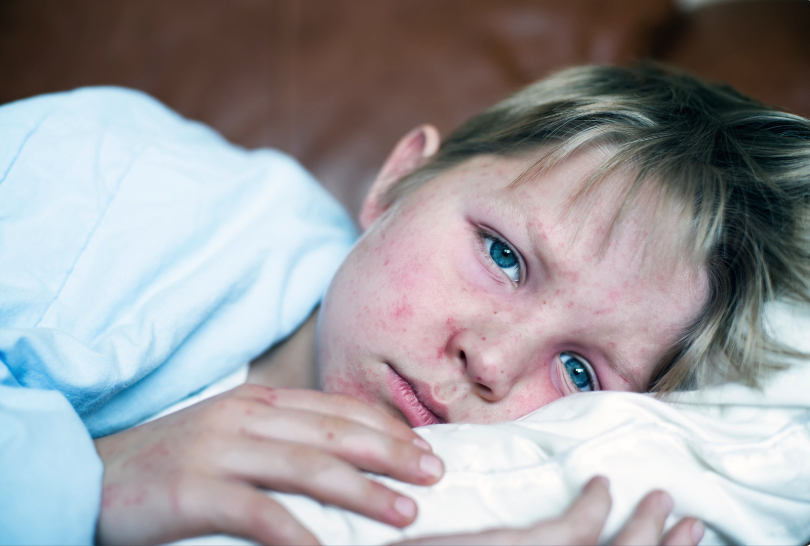
The Measles Rash (Days 14–21 After Exposure)
A deep, red, blotchy rash typically appears 3 to 5 days after the first symptoms start:
- Pattern of spread: Starts on the face (near the hairline or behind the ears) and spreads downward to the neck, trunk, arms, legs, and feet.
- Appearance: Begins as flat red spots that may develop into small raised bumps. As it spreads, spots often merge into larger, splotchy patches.
- Skin tone variations: On darker skin, the rash may appear more purplish or brownish and can be harder to see, though the texture remains palpable.
- Fading: Lasts about 5 to 6 days and fades in the same order it appeared, sometimes leaving brownish discoloration or fine, peeling skin.
When Is a Person Contagious?
A person is contagious for about 8 days total: starting 4 days before the rash appears and ending 4 days after it develops.
Serious Complications of Measles
The primary causes of death and long-term disability from measles involve the respiratory and neurological systems:
- Pneumonia: The most common cause of death from measles in young children. As many as 1 in 20 children with measles develop pneumonia.
- Encephalitis (brain swelling): Occurs in approximately 1 in 1,000 cases and can lead to permanent brain damage, deafness, intellectual disability, or convulsions.
- Death: Even with high-quality medical care, 1 to 3 out of every 1,000 children infected will die from respiratory or neurological complications.
- Hospitalization: In the U.S., about 1 in 5 unvaccinated people who contract measles require hospitalization.
Who Is at Risk if Exposed?
| Immunity Status | Risk Level | Notes |
|---|---|---|
| Unvaccinated | Extremely High | ~90% chance of infection upon exposure. |
| 1 dose of MMR | Low | Approximately 93% effective at preventing infection. |
| 2 doses of MMR | Very Low | Approximately 97% effective; usually provides lifelong protection. |
| Born before 1957 | Presumed Immune | Most were naturally infected as children and have lifelong immunity. |
A Note on Vaccine Response & Waning Immunity
Many consider prior vaccination as guaranteed immunity, but it appears this is not always the case.
Research indicates that between 3% and 10% of vaccinated individuals do not reach or maintain protective levels of IgG antibodies against measles (“vaccine failure”).
Protection can also decline over decades (“waning immunity”).
- Long-term seronegativity: Some studies have found that 12% to 20% of previously vaccinated young adults may lack detectable protective IgG levels roughly 10–15 years after their last dose.
- Annual decline: Measles antibodies in vaccinated populations may decline at a rate of approximately 0.48% per year.
It is important to note that undetectable IgG levels do not always indicate a total lack of protection.
Many vaccinated individuals with low or “negative” IgG titers still possess cell-mediated immunity (T cells), which can trigger a rapid memory response upon exposure, often resulting in milder illness with a lower risk of complications and transmission.
So, What Should You Do?
- Consider checking your immunity with a measles IgG titer to confirm protection. Remember: a previous vaccine does not guarantee immunity. This test can be done at your doctor’s office or ordered through labs like Labcorp.
- Minimum threshold: A measles titer of 120 mIU/mL is widely accepted as the minimum threshold for protection.Some commercial labs use ELISA titers reported as:
- Positive: > 16.5 AU/mL (consistent with immunity)
- Equivocal: 13.5–16.4 AU/mL or Index 0.9–1.0 (indeterminate; may not be fully protected)
- Negative: < 13.4 AU/mL or Index (not consistent with immunity; considered susceptible)
- If you believe you have been exposed and have not received the vaccine or are not immune, the CDC recommends receiving an MMR vaccine within 72 hours of exposure to offer protection and lessen the risk of serious complications.
- If you document that you are no longer immune, it is recommended that you receive an MMR or measles vaccine.
These can be obtained at your doctor’s office, local pharmacy, or health department and are generally covered by insurance.
Frequently Asked Questions About Measles
What are the first symptoms of measles?
Measles typically begins 7–14 days after exposure with high fever (often above 104°F), cough, runny nose, red watery eyes, fatigue, and sore throat. Small white spots inside the mouth (Koplik spots) may appear before the red rash develops.
How long is measles contagious?
A person with measles is contagious for about eight days total — beginning four days before the rash appears and lasting until four days after the rash starts. The virus spreads through airborne droplets and can linger in the air for up to two hours.
How do I know if I’m immune to measles?
You are generally considered immune if you have received two doses of the MMR vaccine, have laboratory-confirmed immunity (positive measles IgG titer), had a previous measles infection, or were born before 1957.
What is a measles IgG titer test?
A measles IgG titer is a blood test that measures protective antibodies against measles. A level of 120 mIU/mL or higher is typically considered protective. This test helps confirm immunity if vaccination history is unclear.
Can vaccinated adults lose measles immunity?
In some individuals, measles antibody levels can decline over time (waning immunity). However, even if IgG levels decrease, many vaccinated individuals still retain immune memory through T-cells, which can reduce severity if exposed.
What should I do if I am exposed to measles?
If you are not immune and believe you were exposed, contact your healthcare provider immediately. The CDC recommends receiving the MMR vaccine within 72 hours of exposure to help reduce the risk of infection and complications.
Who is at highest risk for severe measles complications?
Children under 5, adults over 20, pregnant individuals, immunocompromised patients, and those with vitamin A deficiency are at highest risk for severe complications including pneumonia, encephalitis, and hospitalization.